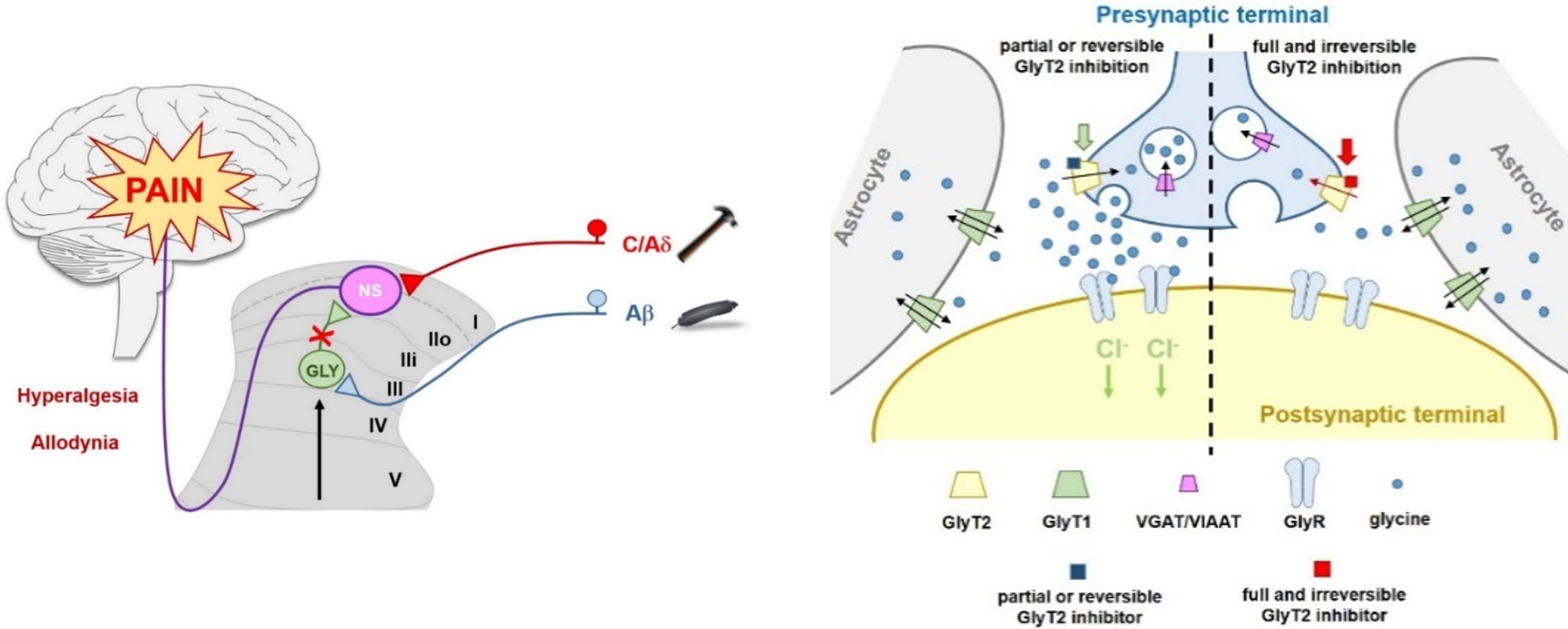
Our research efforts are focused on mitigating the high abuse liability associated with m-opioid analgesics. We are engaged in an NIH-funded collaborative drug discovery project with the University of Sydney that focuses on developing novel and orally bioavailable GlyT2 inhibitors for the treatment of neuropathic pain.
Recent insights into the physiological adaptations underlying chronic pain have encouraged efforts to discover new classes of pain-relieving drugs targeting mechanisms that circumvent m-opioid receptor engagement. Among the myriad of cellular and molecular processes identified as contributing to pathological pain, disinhibition of spinal cord nociceptive signaling to higher cortical centers plays a critical role. We, together with others, have demonstrated that impaired glycinergic neurotransmission develops within the dorsal horn of the spinal cord in neuropathic pain models, and is an important mechanism underlying mechanical hyperalgesia (amplified pain signaling) and allodynia (a painful response to normally innocuous stimuli).
It has been hypothesized that agents capable of augmenting spinal glycinergic neurotransmission may be able to obtund aberrant nociceptor signaling to the brain and serve as a novel class of analgesics. Indeed, drugs that enhance dysfunctional glycinergic transmission in neuropathic pain, and in particular inhibitors of the glycine transporter 2 (GlyT2), are generating widespread interest. GlyT2 inhibitors have demonstrated analgesic efficacy in preclinical pain models. Opiranserin, a dual GlyT2 inhibitor and 5-HT2A antagonist, is in clinical trials for the treatment of post- operative pain. However, a potent, selective, and orally bioavailable GlyT2 inhibitor has yet to reach the clinic.
Our approach presents an opportunity to address the national opioid public health crisis by delivering an analgesic with a novel mechanism of action. We are working towards optimizing novel GlyT2 inhibitors into orally bioavailable preclinical candidates suitable for further development and clinical trials as standalone analgesics or opiod-sparing treatments for neuropathic pain that may help stem OUD.